How to Detect Muons!
TL;DR
Learn to build a muon detector with simple tools.
Transcript
Every hour of every day, a thin cosmic rain of charged particles collides with the earth’s atmosphere, some of which eventually reaches the surface. Until recently, observing and measuring cosmic radiation was the domain of physicists in fancy laboratories. But now, thanks to a group of scientists at MIT and the National Centre for Nuclear Research... Read More
Key Insights
- Cosmic rays originate from supernovae, ejecting interstellar material that creates secondary particles upon hitting Earth's atmosphere.
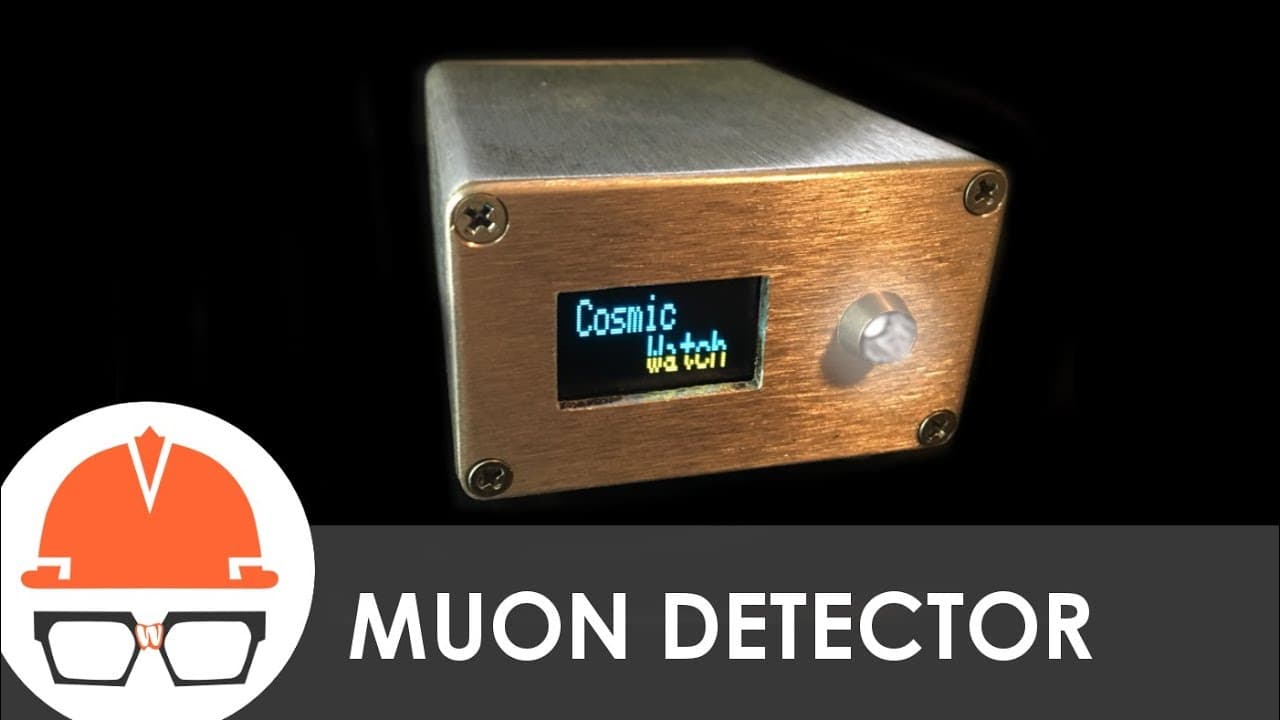
- Muon detectors, like the CosmicWatch, allow amateurs to measure cosmic radiation using scintillators and photomultipliers.
- The scintillator absorbs radiation energy and re-emits it as light, which is then converted into an electric signal by the photomultiplier.
- An Arduino, with a peak detector circuit, measures the signals from the photomultiplier to count muon pulses.
- Using two detectors in coincidence mode helps identify the direction of muons and reduce false readings.
- Experiments can be conducted to test how environmental factors affect muon detection, such as altitude and material shielding.
- The CosmicWatch project is an educational tool that simplifies the experimental design and data collection process.
- XOD offers a visual programming language for microcontrollers, making electronics projects accessible without extensive programming knowledge.
Install to Summarize YouTube Videos and Get Transcripts
Explore YouTube Video Summarizer or Get YouTube Transcript Extractor
Questions & Answers
Q: What is the primary purpose of the CosmicWatch muon detector?
The primary purpose of the CosmicWatch muon detector is to allow individuals, including students and amateur scientists, to detect and measure cosmic radiation, specifically muons, from their own homes or educational settings. It democratizes access to particle physics, making it possible to conduct experiments and gather data without needing expensive, complex equipment.
Q: How does the CosmicWatch detector measure muon pulses?
The CosmicWatch detector measures muon pulses using a combination of a scintillator and a photomultiplier. The scintillator absorbs the energy from a passing muon and emits light, which the photomultiplier then converts into an electric signal. This signal is processed by an Arduino, which counts the pulses and measures their amplitude, allowing for the calculation of detection rates and other parameters.
Q: What experiments were conducted in the video to test the muon detector?
The video describes several experiments conducted to test the muon detector. One experiment measured muon detection rates during the day versus at night, finding negligible differences. Another tested directional detection rates, showing more detections from overhead than from the horizon. A third experiment involved measuring how layers of concrete affected detection rates, demonstrating a reduction in muon counts with increased shielding.
Q: Why is the CosmicWatch project considered a valuable educational tool?
The CosmicWatch project is a valuable educational tool because it simplifies the complex field of particle physics, making it accessible to students and amateur scientists. It provides a hands-on experience in scientific experimentation, allowing users to design experiments, collect data, and analyze results. The project's straightforward setup and operation encourage exploration and learning about cosmic phenomena and the scientific method.
Q: What role does the Arduino play in the muon detector setup?
In the muon detector setup, the Arduino plays a crucial role in processing the signals generated by the photomultiplier. It counts the muon pulses, measures their amplitude, and records the data for analysis. The Arduino's ability to interface with other components, like the peak detector circuit, ensures accurate detection and measurement of the brief signals produced by the muons passing through the scintillator.
Q: How does the peak detector circuit aid in muon detection?
The peak detector circuit aids in muon detection by amplifying and stretching the brief electric signal generated by the photomultiplier. This is necessary because the original signal is extremely short, lasting less than a microsecond, making it difficult for the Arduino to detect. By extending the signal duration, the peak detector ensures that the Arduino can accurately count and measure the muon pulses.
Q: What are the benefits of using XOD in electronics projects?
XOD benefits electronics projects by offering a visual programming language that simplifies the process of working with microcontrollers, like Arduino, without requiring extensive coding knowledge. Its node-based interface allows users to build programs visually, reducing the learning curve and making it easier for beginners to engage in electronics projects. XOD's open-source nature and comprehensive tutorials further support users in creating innovative and functional projects.
Q: How does the CosmicWatch project contribute to citizen science?
The CosmicWatch project contributes to citizen science by enabling non-professionals to participate in scientific research and data collection related to cosmic radiation. It empowers individuals to conduct experiments, gather data, and contribute to a broader understanding of cosmic phenomena. This democratization of science fosters public engagement, education, and collaboration, expanding the reach and impact of scientific inquiry beyond traditional laboratory settings.
Summary & Key Takeaways
-
The video explores the creation of a muon detector using the CosmicWatch project, allowing anyone to measure cosmic radiation. It details the components and functionality of the detector, explaining how scintillators and photomultipliers work together to detect muons.
-
The host conducts experiments to measure muon detection rates under different conditions, such as day versus night and varying detector orientations. The results show minor variations, offering insights into cosmic ray behavior and the factors affecting detection.
-
The video emphasizes the educational value of the CosmicWatch project, highlighting its simplicity and effectiveness in teaching scientific methods. It also introduces XOD, a visual programming tool that simplifies microcontroller projects, making electronics more accessible.
Read in Other Languages (beta)
Share This Summary 📚
Summarize YouTube Videos and Get Video Transcripts with 1-Click
Try YouTube Summary with ChatGPT & Claude or YouTube Transcript Generator
Explore More Summaries from Practical Engineering 📚






Summarize YouTube Videos and Get Video Transcripts with 1-Click
Try YouTube Summary with ChatGPT & Claude or YouTube Transcript Generator