What Is the Best Cardio for Fat Loss?

TL;DR
The most effective cardio for fat loss varies based on individual fitness levels and goals. High-intensity interval training (HIIT) burns more fat in less time but requires a higher fitness level and can be taxing. Low-intensity steady state (LISS) is more sustainable and suitable for most people, promoting recovery and longevity. Balancing cardio with resistance training is crucial for optimal results.
Transcript
if you want to pump your body and expand your mind there's only one place to go mind fight with your hosts Sal de Stefano Adam Schaefer and Justin Andrews in this episode of mind pump the mind pump so we get this question all the time what is the best form of cardio to burn body fat mmm there's a lot of different forms of cardio different modalitie... Read More
Key Insights
- HIIT burns more body fat and preserves muscle better than LISS but requires higher fitness levels.
- LISS is suitable for almost anyone and is more sustainable long-term, promoting recovery and longevity.
- Cardio is the most effective way to burn calories per time spent but can slow metabolism if overdone.
- Resistance training boosts metabolism by building muscle, which burns more calories at rest.
- The most effective fat loss strategy combines resistance training with some cardio for health benefits.
- Over-reliance on cardio can lead to muscle loss and a slower metabolism over time.
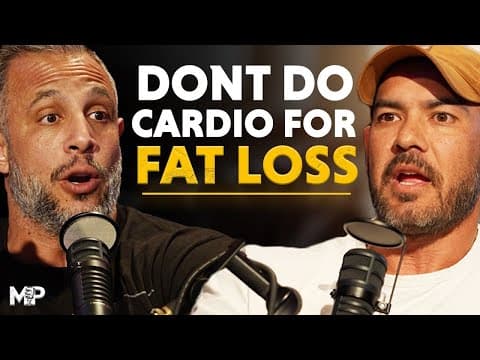
- Cardio should be used for overall health benefits rather than as the primary method for fat loss.
- The best cardio modality is the one you enjoy and can perform with good form without injury.
Install to Summarize YouTube Videos and Get Transcripts
Explore YouTube Video Summarizer or Get YouTube Transcript Extractor
Questions & Answers
Q: How does high-intensity interval training (HIIT) compare to low-intensity steady state (LISS) for fat loss?
HIIT is more effective for burning fat in a shorter amount of time compared to LISS. It preserves muscle mass better due to its higher intensity, which mimics resistance training. However, HIIT requires a higher fitness level and can be more taxing on the body. LISS, on the other hand, is more sustainable and suitable for a wider range of fitness levels, promoting recovery and overall health.
Q: What are the benefits of incorporating resistance training into a fat loss routine?
Resistance training is crucial for boosting metabolism as it helps build muscle, which burns more calories at rest. It sends a signal to the body to prioritize muscle growth over calorie efficiency, leading to a faster metabolism. This approach allows for greater calorie intake without weight gain, making it easier to maintain fat loss long-term. Additionally, resistance training provides health benefits similar to those of cardio.
Q: Why might over-relying on cardio for fat loss be counterproductive?
Over-relying on cardio, especially LISS, can lead to muscle loss and a slower metabolism. The body adapts by becoming more efficient at conserving energy, which can result in less muscle mass and a decreased calorie burn at rest. This adaptation makes it harder to maintain fat loss long-term. A balanced approach that includes resistance training is more effective for sustainable fat loss.
Q: How can cardio be effectively incorporated into a fitness routine for fat loss?
Cardio should complement resistance training by providing health benefits and aiding recovery. For most people, a combination of LISS and occasional HIIT, depending on fitness levels, is effective. LISS can be done more frequently to promote recovery and longevity, while HIIT can be included once or twice a week for additional fat-burning benefits. The key is to balance cardio with resistance training for optimal results.
Q: What factors should be considered when choosing a cardio modality?
The most important factors when choosing a cardio modality are personal enjoyment and the ability to perform it safely with good form. Different modalities, such as walking, cycling, or using an elliptical, can be effective as long as they are performed consistently and without injury risk. It's also important to consider individual fitness levels and goals when selecting a cardio type.
Q: What are the potential downsides of not including any cardio in a fitness routine?
Excluding cardio from a fitness routine can result in missing out on the cardiovascular health benefits it provides, such as improved heart and lung function. It may also lead to decreased stamina and endurance over time. Incorporating some cardio into a routine can enhance overall health and improve performance in resistance training by boosting stamina and recovery.
Q: How does resistance training affect metabolism compared to cardio?
Resistance training boosts metabolism by promoting muscle growth, which increases the number of calories burned at rest. This effect is long-lasting, as the body continues to burn more calories even after the workout. In contrast, the calorie-burning effects of cardio are limited to the duration of the exercise session. Resistance training is more effective for long-term metabolism enhancement.
Q: When is the best time to introduce cardio into a fitness routine focused on fat loss?
Cardio is best introduced into a fitness routine after establishing a solid foundation of resistance training and achieving a sufficient calorie intake that supports muscle maintenance. This approach ensures that the body is in a good metabolic state and can handle the additional calorie deficit created by cardio. Starting with LISS and gradually incorporating HIIT as fitness levels improve is recommended.
Summary & Key Takeaways
-
High-intensity interval training (HIIT) is effective for burning fat quickly and preserving muscle, but it requires a higher fitness level and can be taxing. It's best for those who are already fit and can handle the intensity. In contrast, low-intensity steady state (LISS) is more sustainable and suitable for most people, promoting recovery and longevity.
-
Resistance training is crucial for boosting metabolism and should be the primary focus for fat loss. Cardio can complement this by providing health benefits and aiding recovery when done correctly. The ideal routine includes a balance of resistance training and some cardio, tailored to individual goals and fitness levels.
-
Over-reliance on cardio, particularly LISS, can lead to muscle loss and a slower metabolism, as the body becomes more efficient at conserving energy. Cardio should be used for its health benefits rather than as the primary method for fat loss. The best approach is to let metabolism do the calorie burning through resistance training while using cardio for overall health.
Read in Other Languages (beta)
Share This Summary 📚
Summarize YouTube Videos and Get Video Transcripts with 1-Click
Try YouTube Summary with ChatGPT & Claude or YouTube Transcript Generator
Explore More Summaries from Mind Pump Show 📚


Summarize YouTube Videos and Get Video Transcripts with 1-Click
Try YouTube Summary with ChatGPT & Claude or YouTube Transcript Generator