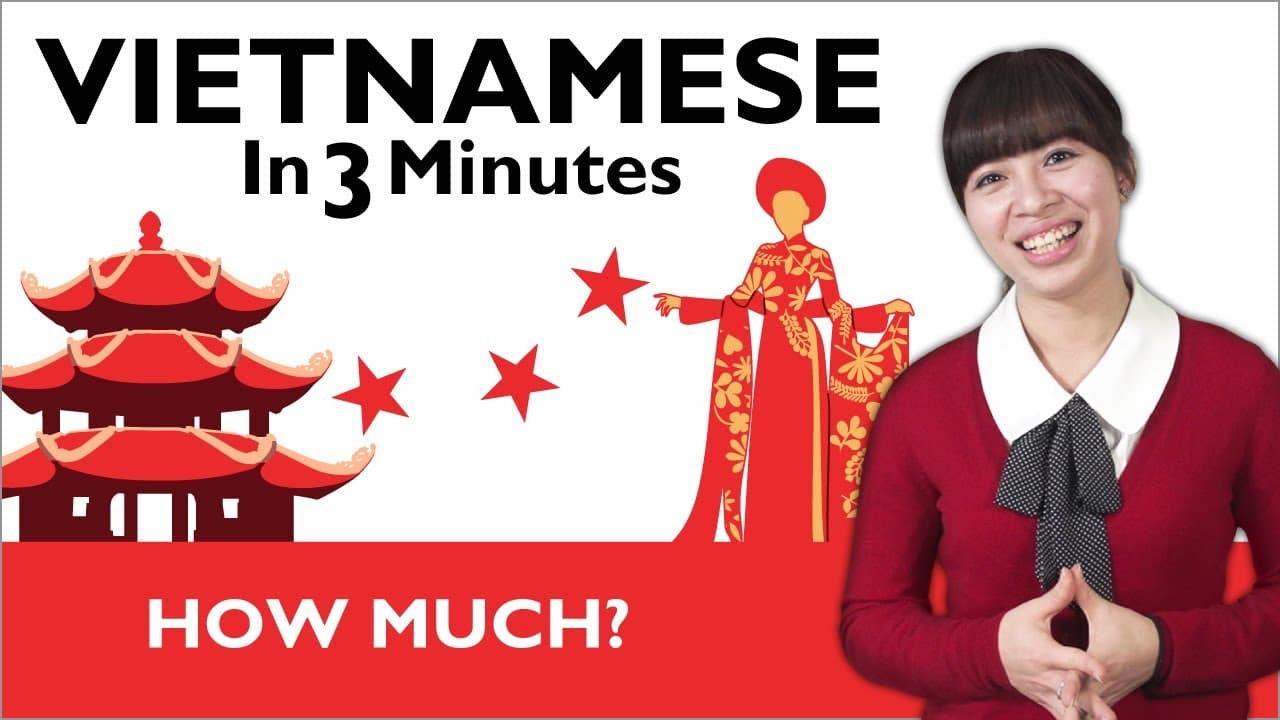
Learn Vietnamese - Vietnamese in Three Minutes - How Much?
TL;DR
Learn how to ask prices in Vietnamese while shopping.
Transcript
until Phil allow hi everybody arms out welcome to Vietnamese part 101 coms my food hopped in Viet the fastest easiest and most fun way to learn Vietnamese in the last lesson we learned how to count in Vietnamese I hope you spend some time practicing the numbers because they will come in handy in this lesson we are going to learn how to go shopping ... Read More
Key Insights
- The lesson focuses on teaching basic Vietnamese phrases for shopping, specifically how to ask for prices in a market setting.
- The phrase 'sin-hye' is used to politely get attention, similar to saying 'excuse me' in English.
- To ask for the price of a specific item, use the structure: 'sin-hye [classifier] [object] [na] [bao nhieu tien]'.
- Classifiers are essential in Vietnamese when referring to objects or animals, such as 'cai' for objects and 'con' for animals.
- Prices in Vietnam are often expressed in thousands, as the currency unit 'dong' is implied and not always stated.
- Vietnamese sentences often end with particles like 'na' to make speech sound more natural and melodic.
- The lesson is part of a series aimed at helping beginners learn Vietnamese in a fun and engaging way.
- Additional resources, such as a free eBook, are available to help learners expand their vocabulary and improve language skills.
Install to Summarize YouTube Videos and Get Transcripts
Explore YouTube Video Summarizer or Get YouTube Transcript Extractor
Questions & Answers
Q: How do you politely ask for the price of an item in Vietnamese?
To politely ask for the price of an item in Vietnamese, you use the phrase 'sin-hye' followed by the classifier and the object. For example, 'sin-hye cai mu na bao nhieu tien' translates to 'Excuse me, how much is this hat?' This structure ensures clarity and politeness in communication.
Q: What role do classifiers play in Vietnamese shopping phrases?
Classifiers are crucial in Vietnamese as they specify the type of noun being referred to. When asking for prices, classifiers like 'cai' for objects and 'con' for animals are used. This specificity helps in accurately identifying items, making conversations clear and effective, especially in a shopping context.
Q: Why is the currency unit 'dong' often omitted in Vietnamese price expressions?
In Vietnamese, the currency unit 'dong' is often omitted because prices are typically expressed in thousands. This convention simplifies communication and reflects the high numerical values commonly associated with the local currency. Understanding this cultural nuance is essential for effective communication in financial transactions.
Q: What is the purpose of particles like 'na' in Vietnamese sentences?
Particles like 'na' are used at the end of Vietnamese sentences to make speech sound more natural and melodic. They help soften questions, making them sound more polite and intimate. This linguistic feature is important for creating a friendly and approachable tone in conversations, especially in social settings.
Q: What additional resources are provided by VietnamesePod101 for learners?
VietnamesePod101 offers additional resources such as a free eBook containing 2000 everyday Vietnamese words. This resource is designed to help learners expand their vocabulary and improve their language skills. By signing up for a free lifetime account, learners can access these materials without any financial commitment.
Q: How does VietnamesePod101 make learning Vietnamese engaging?
VietnamesePod101 makes learning Vietnamese engaging by offering structured lessons that are both fun and educational. The platform uses a combination of video lessons, interactive exercises, and additional resources like eBooks to cater to different learning styles. This approach helps maintain learner interest and facilitates effective language acquisition.
Q: What is the importance of learning shopping phrases in Vietnamese?
Learning shopping phrases in Vietnamese is important for practical communication in everyday situations. It enables learners to navigate markets, negotiate prices, and interact with vendors confidently. These skills are essential for anyone living in or visiting Vietnam, as they enhance the overall experience and foster cultural understanding.
Q: How does understanding Vietnamese currency impact shopping experiences?
Understanding Vietnamese currency impacts shopping experiences by allowing for accurate financial transactions. Knowing that prices are often expressed in thousands and that 'dong' is implied helps prevent misunderstandings. This knowledge ensures that learners can manage their finances effectively while shopping in Vietnam, leading to more positive and seamless interactions.
Summary & Key Takeaways
-
The video lesson teaches essential Vietnamese phrases for shopping, focusing on how to ask for prices. It emphasizes the use of classifiers and polite expressions to make interactions smoother. Learners are introduced to the structure of asking for prices and the cultural nuances of the Vietnamese language.
-
Understanding the Vietnamese currency system is crucial for accurate communication in markets. The lesson explains that prices are typically spoken in thousands, and the currency unit 'dong' is often omitted in conversation. This knowledge helps learners better navigate shopping experiences in Vietnam.
-
The lesson is part of a broader initiative by VietnamesePod101 to make learning Vietnamese accessible and enjoyable. It provides additional resources like a free eBook to enhance vocabulary and comprehension, encouraging learners to practice both listening and speaking skills for effective communication.
Read in Other Languages (beta)
Share This Summary 📚
Summarize YouTube Videos and Get Video Transcripts with 1-Click
Try YouTube Summary with ChatGPT & Claude or YouTube Transcript Generator
Explore More Summaries from Learn Vietnamese with VietnamesePod101.com 📚


Summarize YouTube Videos and Get Video Transcripts with 1-Click
Try YouTube Summary with ChatGPT & Claude or YouTube Transcript Generator